When you're investing in a patio cover in Texas, the material you choose affects everything — how it looks the first day, how it holds up after five brutal summers, how much maintenance it demands, and what it does for your home's resale value. This isn't a decision you want to get wrong, because the Texas climate will punish the wrong choice fast.
We've built over 150 patio covers across Dallas-Fort Worth, and the material conversation comes up in every single consultation. Homeowners want to know what lasts, what looks best, and what gives them the most value for their dollar. This guide lays out the honest truth about each option — cedar, pressure-treated pine, aluminum, and vinyl — so you can make the right call for your home.
Why Material Choice Matters in Texas
Texas weather isn't just "hot." It's a specific combination of conditions that stress outdoor structures in ways most regions don't:
- Extreme UV exposure: DFW averages 234 sunny days per year. Prolonged UV breaks down finishes, fades color, and degrades unprotected wood fibers over time.
- Summer heat: Surface temperatures on a south-facing patio cover can exceed 150°F during July and August. Materials expand, contract, and warp under that kind of thermal cycling.
- Severe storms: North Texas sits in the heart of hail alley. Straight-line winds from spring thunderstorms regularly hit 60–70 mph, and hailstones the size of golf balls aren't uncommon.
- Humidity swings: DFW isn't consistently humid like Houston, but we get stretches of 70–80% humidity in spring and fall, followed by dry spells. This expansion-contraction cycle is particularly tough on wood that isn't sealed properly.
- Mild but variable winters: Occasional ice storms (remember February 2021) put load stress on patio cover roofing and connections.
The point is simple: what works in Portland or Phoenix may fail in Dallas. You need materials tested against this exact climate profile.
Western Red Cedar
Cedar is the premium wood choice for patio covers in North Texas, and it's what we use most often at Structure1 Construction. Here's why — and where it falls short.
Pros
- Natural insect resistance. Cedar contains thujaplicins, natural oils that repel termites, carpenter ants, and other wood-boring insects. In Texas, where subterranean termites are aggressive, this matters.
- Dimensional stability. Cedar has a lower shrinkage coefficient than most softwoods, meaning it warps, cups, and twists less as moisture levels change. It handles DFW's humidity swings better than pine.
- Beautiful grain and color. Fresh cedar ranges from warm honey to reddish-brown tones. It stains beautifully and can be finished to match any home exterior.
- Lightweight yet strong. Cedar's strength-to-weight ratio makes it easier to work with during construction and puts less stress on attachment points to your home.
- Accepts stain and sealant well. Cedar's open grain structure absorbs stain evenly, giving you a consistent finish that penetrates deep rather than sitting on the surface.
Cons
- Higher upfront cost. Cedar costs 40–60% more than pressure-treated pine for the same dimensional lumber, and that difference grows with the size of the structure.
- Requires regular maintenance. You'll need to re-stain or reseal cedar every 2–3 years in DFW to maintain its appearance and protection. Skip this, and it will gray out and eventually deteriorate.
- Softer wood. Cedar dents and scratches more easily than harder woods. This rarely matters for a patio cover structure, but it's worth noting.
- Color fades without treatment. Left untreated, cedar turns a silvery gray within 6–12 months. Some homeowners like this patina — most don't.
What Drives the Cost
- Materials: Structural-grade western red cedar is the premium wood option, so the material line runs higher than pine for the same footprint.
- Installed patio cover (DFW): Final cost depends on size, roof style, and finish. Cedar is most often paired with stain-grade finishes and tongue-and-groove ceilings, which add labor.
Expected Lifespan
- With regular maintenance: 25–40+ years
- Without maintenance: 15–20 years before significant deterioration
Pressure-Treated Pine
Pressure-treated (PT) lumber is the workhorse of outdoor construction in Texas. It's affordable, widely available, and engineered to resist rot and insects. But it has real trade-offs.
Pros
- Significantly cheaper. PT pine is the most budget-friendly structural wood for patio covers. Expect to save 30–50% on materials compared to cedar.
- Excellent rot resistance. The pressure-treatment process forces preservatives deep into the wood fibers, providing ground-contact-rated protection against fungal decay.
- Insect resistant. Modern PT lumber uses micronized copper azole (MCA) or alkaline copper quaternary (ACQ) preservatives that are highly effective against termites and other insects.
- Readily available. Every lumber yard in DFW stocks PT pine in standard dimensions. No special orders, no lead times.
- Strong. Southern yellow pine (the species most commonly pressure-treated) is actually harder and stronger than cedar. It holds fasteners extremely well.
Cons
- Warping and twisting. This is the biggest issue. PT lumber arrives from the yard with high moisture content from the treatment process, and as it dries in the Texas heat, it can warp, twist, cup, and check (develop surface cracks). Selecting straight boards and allowing them to acclimate helps, but it never fully eliminates the problem.
- Less attractive grain. PT pine has a greenish tint from the copper-based preservatives and a more utilitarian appearance. It can be stained, but it doesn't take stain as evenly or attractively as cedar.
- Must dry before finishing. You typically need to wait 2–4 weeks after installation before staining PT lumber, because the treatment chemicals need to off-gas and the moisture content needs to drop below 15%.
- Heavier. PT southern yellow pine is denser and heavier than cedar, which means more weight on your home's fascia board and ledger connections.
- Chemical treatment concerns. While modern PT preservatives are considered safe by the EPA for residential use, some homeowners prefer a naturally resistant option.
What Drives the Cost
- Materials: The most economical structural lumber available, which is why it anchors most budget-focused builds.
- Installed patio cover (DFW): Final cost is driven by size, roof style, and whether you add a painted finish or wrapped posts. The framing itself is the lowest-cost part of the equation.
Expected Lifespan
- With regular maintenance: 20–30 years
- Without maintenance: 12–18 years
Aluminum Patio Covers
Aluminum covers are factory-built, powder-coated structures that offer a completely different value proposition than wood. They dominate in some Sun Belt markets and have a loyal following for good reason.
Pros
- Virtually zero maintenance. Once installed, an aluminum cover requires nothing more than occasional hosing off. No staining, no sealing, no painting.
- Won't rot, warp, or attract insects. Aluminum is impervious to the biological threats that affect wood. Termites won't touch it. Moisture won't decay it.
- Fire resistant. Aluminum is non-combustible, which can matter if you're using your patio cover over a grilling area or fire pit.
- Long lifespan. Quality aluminum covers can last 30–50+ years with the powder-coated finish intact.
- Consistent appearance. Factory finishes are uniform and available in dozens of colors. No grain variation, no knots, no natural imperfections.
Cons
- Looks like aluminum. There's no getting around it — aluminum covers have a manufactured, commercial appearance that doesn't match the warmth and character of real wood. For many DFW homeowners investing in their backyard, aesthetics are a dealbreaker.
- Denting from hail. North Texas hailstorms will dent aluminum panels. A bad storm can leave a patio cover looking like a golf ball. This is the single biggest drawback for DFW homeowners.
- Heat conduction. Aluminum absorbs and radiates heat. Without insulated panels, the underside of an aluminum cover can feel noticeably warmer than a wood structure. Some insulated models address this, but they cost more.
- Limited customization. Aluminum covers come in standard sizes and configurations. Custom sizes, angles, or designs are either unavailable or significantly more expensive than custom wood builds.
- Noise in rain. A heavy Texas thunderstorm on an aluminum roof is loud. Some homeowners find this charming; most find it disruptive.
- Lower perceived value. Real estate agents in DFW consistently report that wood structures are more attractive to buyers than aluminum ones.
What Drives the Cost
- Materials: Quality insulated aluminum panels cost more than basic lumber, but the system goes up quickly with less on-site labor.
- Installed patio cover (DFW): Final cost depends on panel grade, span, and whether electrical is integrated into the panel system.
Expected Lifespan
- 30–50+ years (primarily limited by finish wear and hail damage)
Vinyl Patio Covers
Vinyl patio covers use PVC or composite vinyl components, often over an internal aluminum or steel frame for structural support. They're the least common option in DFW but worth understanding.
Pros
- Low maintenance. Vinyl won't rot, rust, or need painting. Cleaning with soap and water is about the extent of it.
- Insect proof. Termites and other wood-boring insects have no interest in PVC.
- Won't conduct as much heat as aluminum. Vinyl is a poorer thermal conductor than metal, so it doesn't radiate as much heat.
- Color runs through the material. Unlike painted or coated products, vinyl's color is part of the material itself, so scratches don't expose a different color underneath.
Cons
- UV degradation. This is the fatal flaw in Texas. Vinyl becomes brittle, yellows, and cracks under sustained UV exposure. DFW's 234 sunny days per year accelerate this dramatically. Most vinyl patio covers in our market show visible degradation within 8–12 years.
- Limited structural strength. Vinyl alone isn't strong enough for large spans. Covers require internal metal reinforcement, which adds cost and complexity.
- Cheap appearance. Most vinyl patio covers look noticeably plastic. In a market where homeowners are making a serious investment in outdoor living, the aesthetic doesn't measure up.
- Thermal expansion. Vinyl expands and contracts significantly with temperature changes. In Texas, where surface temperatures can swing 80°F+ between a winter morning and a summer afternoon, this movement creates gaps, buckles, and creaking.
- Poor wind resistance. Lightweight vinyl panels are more susceptible to wind uplift during severe storms. This is a genuine safety concern in North Texas.
- Very limited contractor support. Finding a contractor in DFW who specializes in vinyl patio covers is difficult because demand is low. That means fewer options, less competitive pricing, and harder warranty claims.
What Drives the Cost
- Materials: Vinyl is priced as a budget material, but the internal metal reinforcement required for any real span offsets much of the savings.
- Installed patio cover (DFW): Final cost depends on span, reinforcement, and the limited pool of installers who work with it.
Expected Lifespan
- In Texas: 10–15 years before significant UV degradation
- In milder climates: 20–25 years
Material Comparison Table
Here's a side-by-side look at all four options for a typical 14×20 patio cover in DFW:
| Feature | Western Red Cedar | Pressure-Treated Pine | Aluminum | Vinyl | |---|---|---|---|---| | Lifespan (Texas) | 25–40+ years | 20–30 years | 30–50+ years | 10–15 years | | Maintenance | Re-stain every 2–3 years | Re-stain every 2–3 years | Hose off occasionally | Wash with soap/water | | Hail Resistance | Good — absorbs impact | Good — absorbs impact | Poor — dents easily | Fair — can crack | | Wind Resistance | Excellent | Excellent | Good | Fair | | UV Resistance | Good with stain/sealant | Good with stain/sealant | Excellent | Poor | | Insect Resistance | Natural resistance | Chemical resistance | N/A — no risk | N/A — no risk | | Aesthetics | Premium, natural warmth | Utilitarian, can be stained | Manufactured, uniform | Plastic appearance | | Customization | Unlimited | Unlimited | Limited sizes/styles | Limited sizes/styles | | Resale Value Impact | High | Moderate | Low-moderate | Low | | Noise in Rain | Quiet (with solid roof) | Quiet (with solid roof) | Loud | Moderate |
What We Recommend (and Why)
At Structure1 Construction, we build patio covers primarily with western red cedar and pressure-treated southern yellow pine. Here's our honest reasoning:
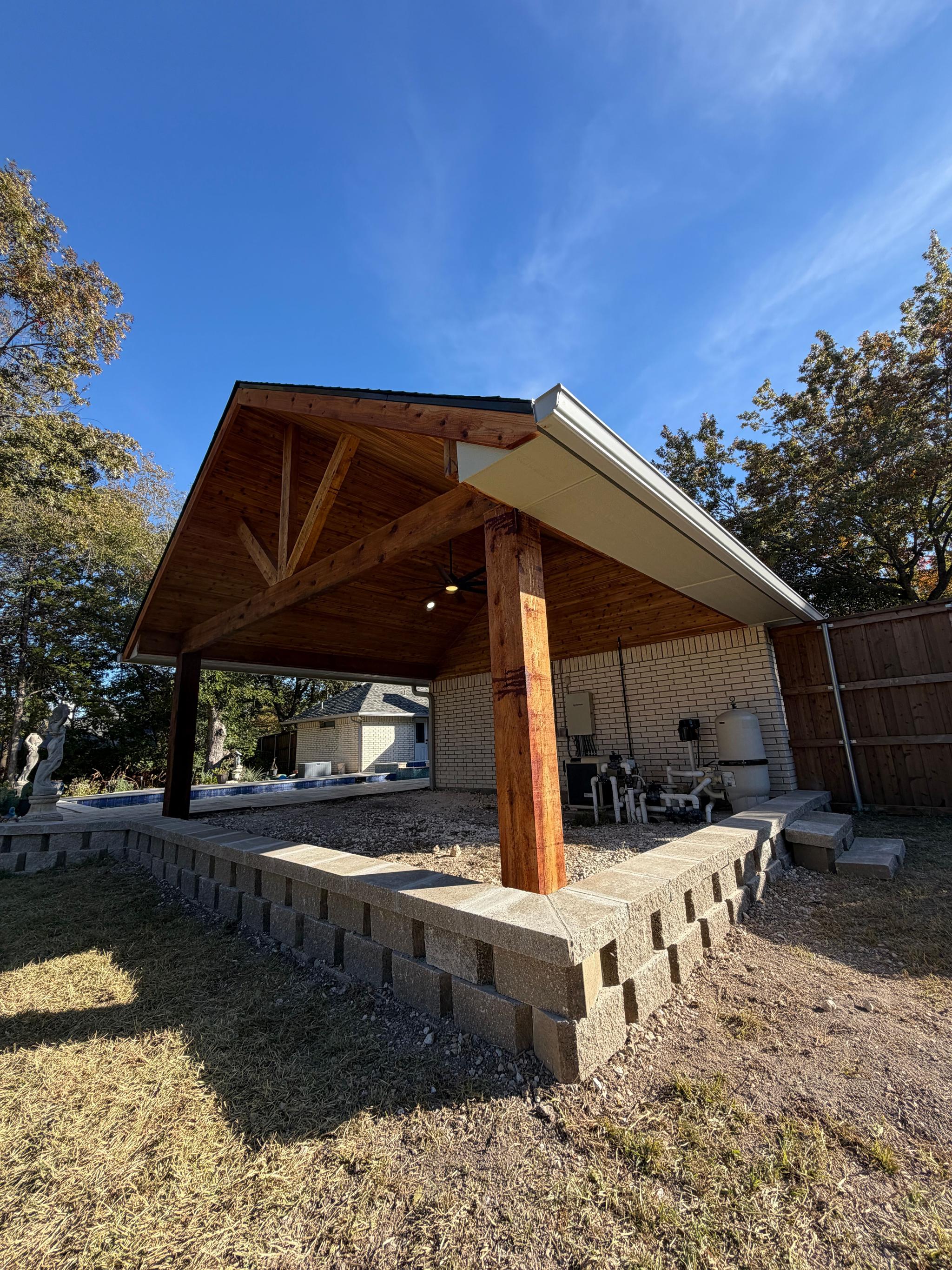
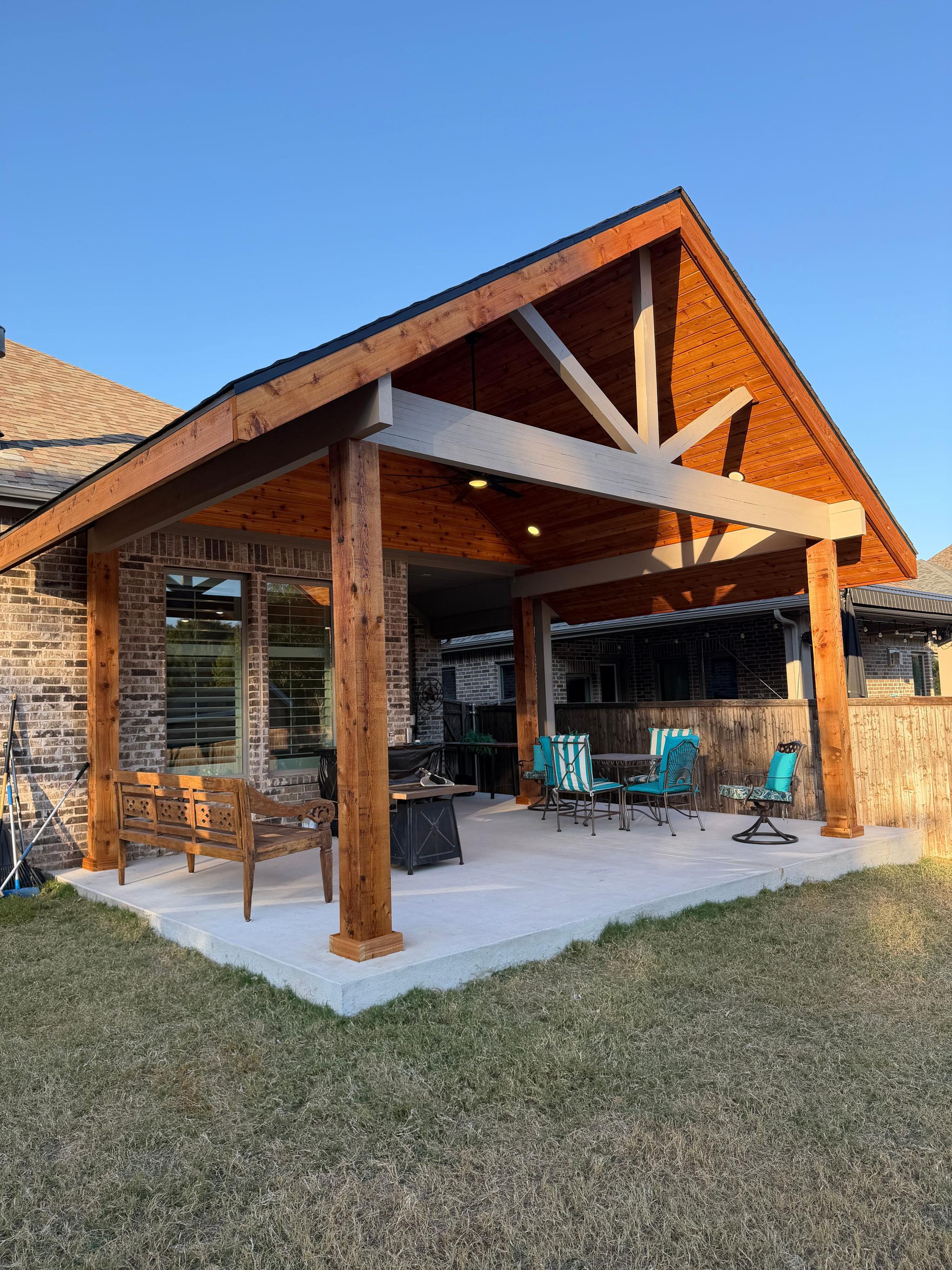
Cedar is our top recommendation for homeowners who want a patio cover that looks premium, ages gracefully, and adds genuine value to their home. The higher upfront cost pays for itself through aesthetics, durability, and buyer appeal. When we build a custom gable or open-rafter patio cover with cedar posts, beams, and a tongue-and-groove ceiling, the result is a structure that genuinely transforms a backyard.
Pressure-treated pine is our recommendation for budget-conscious projects where the priority is getting covered outdoor space at a reasonable price. We use it frequently for posts and structural framing, especially on lean-to covers where the structure is less visually prominent. PT pine is honest, reliable material — it just needs proper finishing.
We often combine both in a single project. A common approach we use: pressure-treated framing for the structural skeleton (rafters, joists, ledger board) with cedar for the visible elements (posts, beams, fascia, ceiling). This gives you the beauty of cedar where it matters most while keeping the overall cost down.
We don't install aluminum or vinyl covers. Not because they're terrible products — they serve their purpose in some markets and situations. But our customers in DFW are typically looking for a structure that feels like a genuine extension of their home, not an add-on appliance. Wood delivers that in a way aluminum and vinyl simply can't.
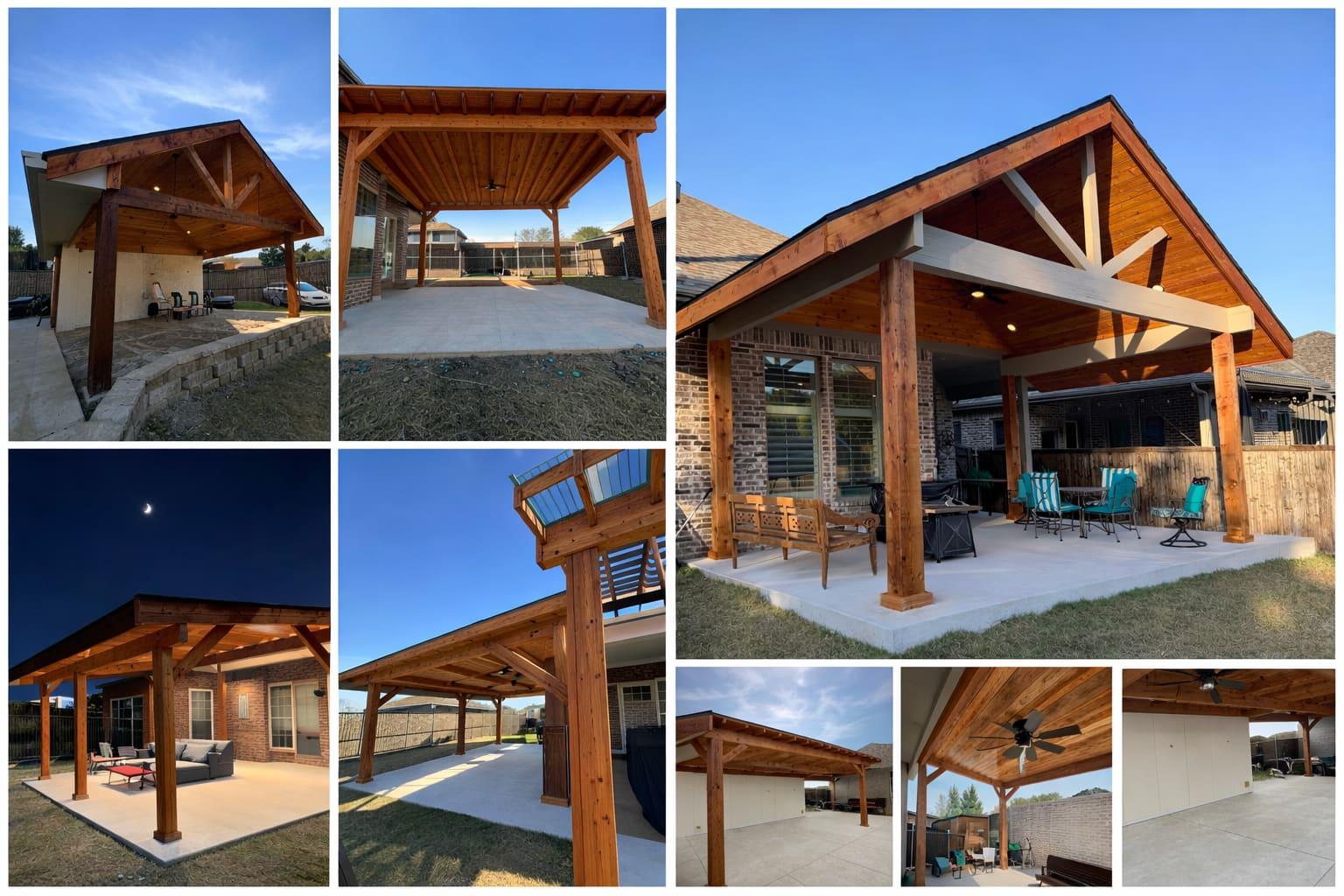
If you want to see how these materials look in finished projects, check out our project gallery for examples from across the Dallas-Fort Worth area.
Roofing Material Options
The material you choose for the cover structure is only half the equation. Here's what goes on top:
Asphalt Shingles
The most popular choice for attached patio covers in DFW because they match your existing roof. We typically use architectural-grade shingles (30-year rated) in a color that complements your home. Cost is moderate, installation is straightforward, and replacement is simple when the time comes.
Best for: Gable and lean-to covers attached to the home where you want a seamless, cohesive look.
Standing Seam Metal
Metal roofing is gaining popularity for patio covers, especially on modern and transitional-style homes. Standing seam panels shed water efficiently, reflect heat better than shingles, and can last 40–50+ years. They're more expensive than shingles but require virtually no maintenance.
Best for: Modern homes, freestanding structures, and homeowners who want maximum longevity.
Polycarbonate Panels
Multi-wall polycarbonate panels let filtered light through while blocking UV and shedding rain. They're the go-to roofing for patio covers where you want weather protection without losing the open, airy feel. Quality panels are rated for hail up to 1 inch in diameter.
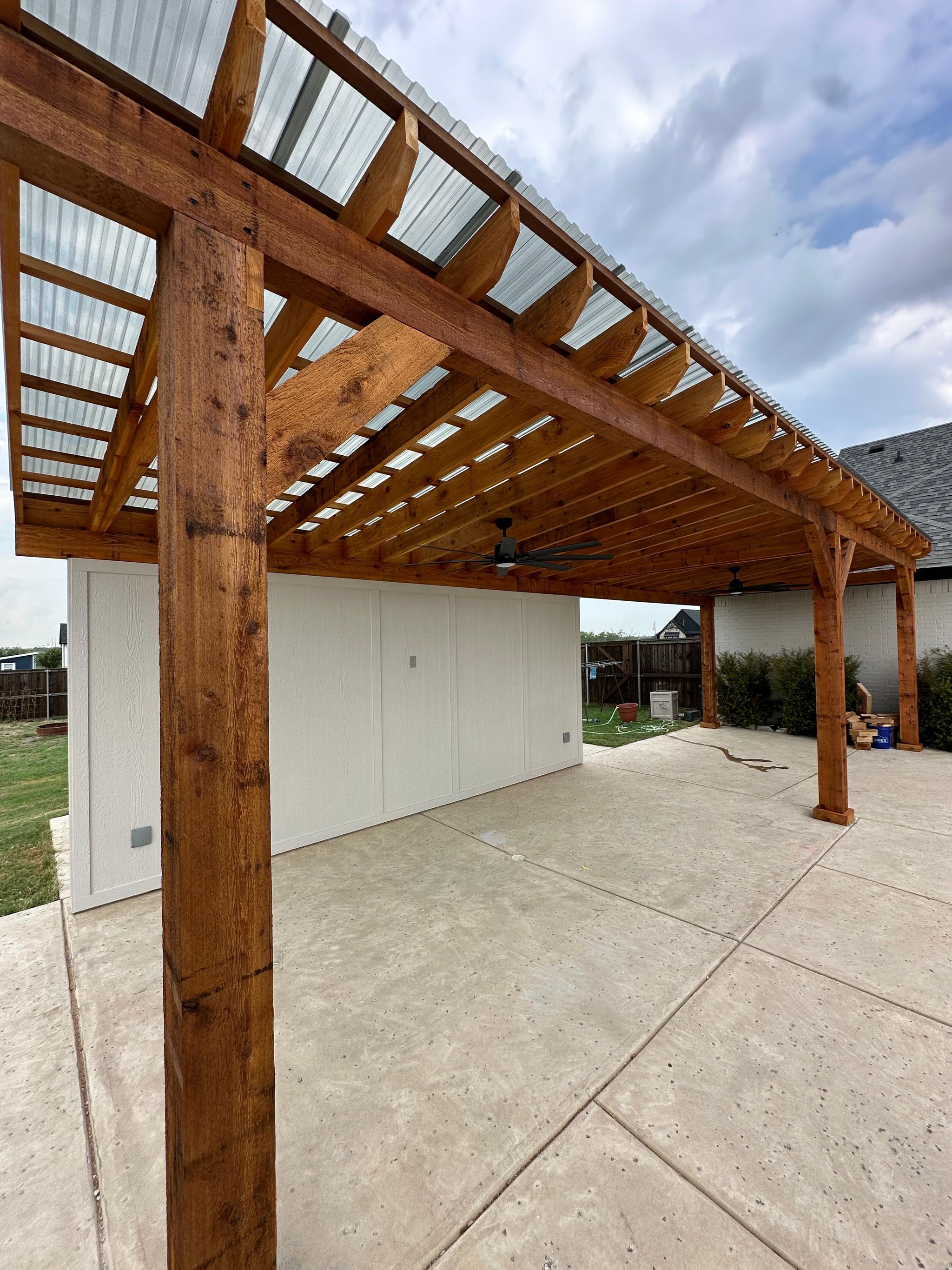
Best for: Polycarbonate patio covers where you want light transmission and rain protection. We use polycarbonate frequently on our patio cover builds throughout the DFW area.
Open Rafters (No Roofing)
Open-rafter patio covers with spaced rafters and no solid roofing provide partial shade through the lattice effect. They're the most affordable roof option (because there's no roof) and create beautiful light-and-shadow patterns. The trade-off is zero rain protection.
Best for: Decorative open-rafter covers, garden structures, and homeowners who want partial shade without full coverage.
Choosing the Right Material for Your Project
Still not sure which direction to go? Here's a quick decision framework:
- Want the best-looking result and plan to maintain it? Go with cedar. You won't regret it.
- Need to keep costs down but still want wood? Pressure-treated pine with quality stain is a solid choice.
- Want zero maintenance and don't mind the look? Aluminum is worth considering, but budget for hail damage over time.
- On a tight budget in a rental property? Vinyl works in the short term, but don't expect it to last in Texas heat.
For most DFW homeowners we work with, the answer lands on cedar or a cedar-and-pine combination. It's the material that makes the most sense when you factor in appearance, longevity, resale value, and total cost of ownership over 20+ years.
Wondering what goes into the cost of a patio cover? Check out our guide to what determines patio cover cost in DFW or explore the different types of patio covers to figure out which style fits your home best.
Ready to talk materials and get a real estimate? Get a free estimate from Structure1 Construction. We'll walk through your options, show you material samples, and give you an honest quote for your specific project. Call us at (580) 665-2758 or fill out our contact form — we typically respond within 24 hours.