Choosing a patio cover style isn't just about looks — though looks absolutely matter. The style you pick determines how much shade you get, how the structure handles DFW storms, what it costs, and how well it integrates with your home's architecture. Pick the wrong style and you end up with a structure that feels like an afterthought. Pick the right one and your outdoor space looks like it was always part of the original build.
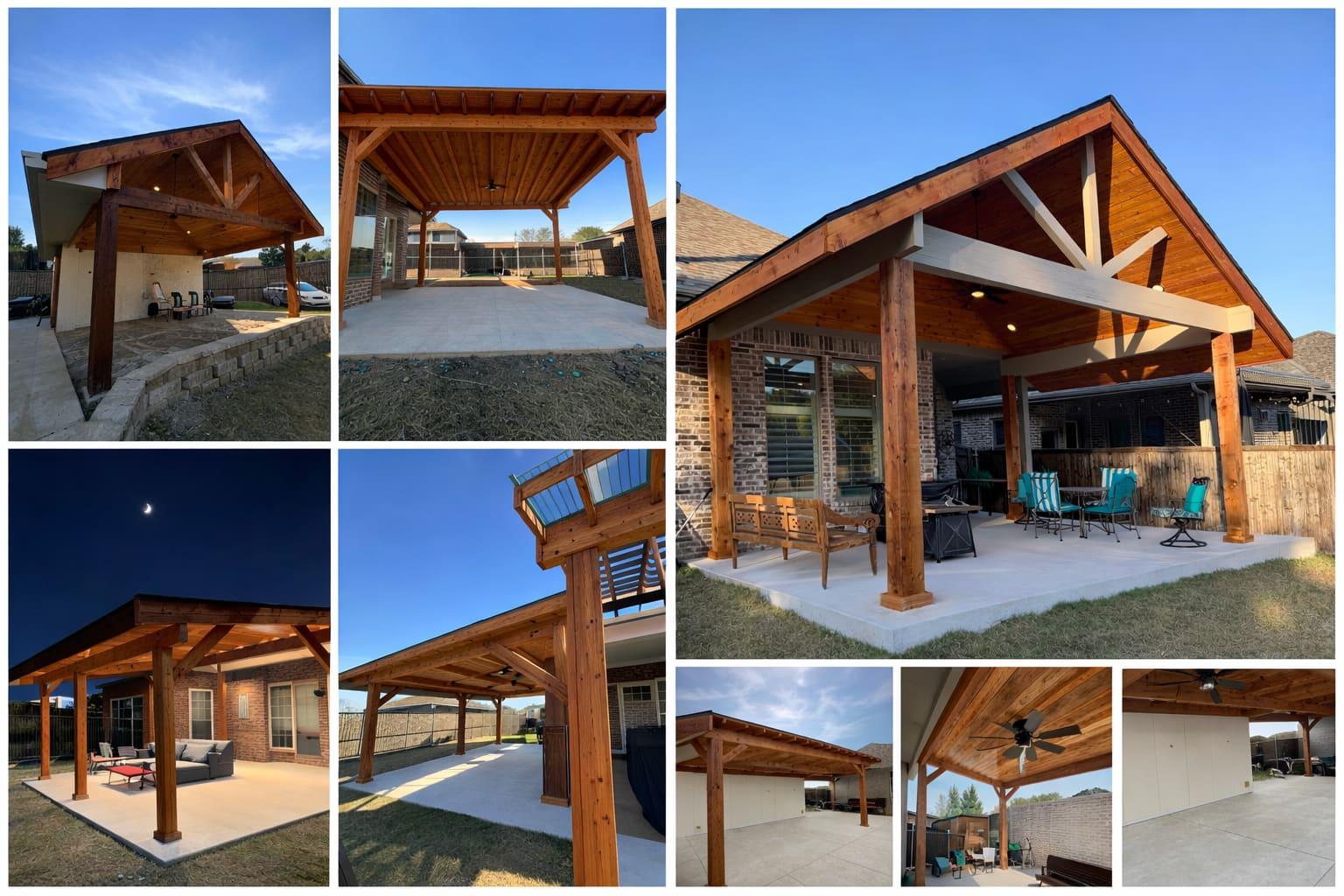
At Structure1 Construction, we've built every style of patio cover across Dallas-Fort Worth over the past four years — gable, lean-to, open-rafter, polycarbonate, hip, and custom combinations. This guide walks you through each option with honest pros, cons, pricing, and guidance on which style fits your situation.
Gable Patio Covers
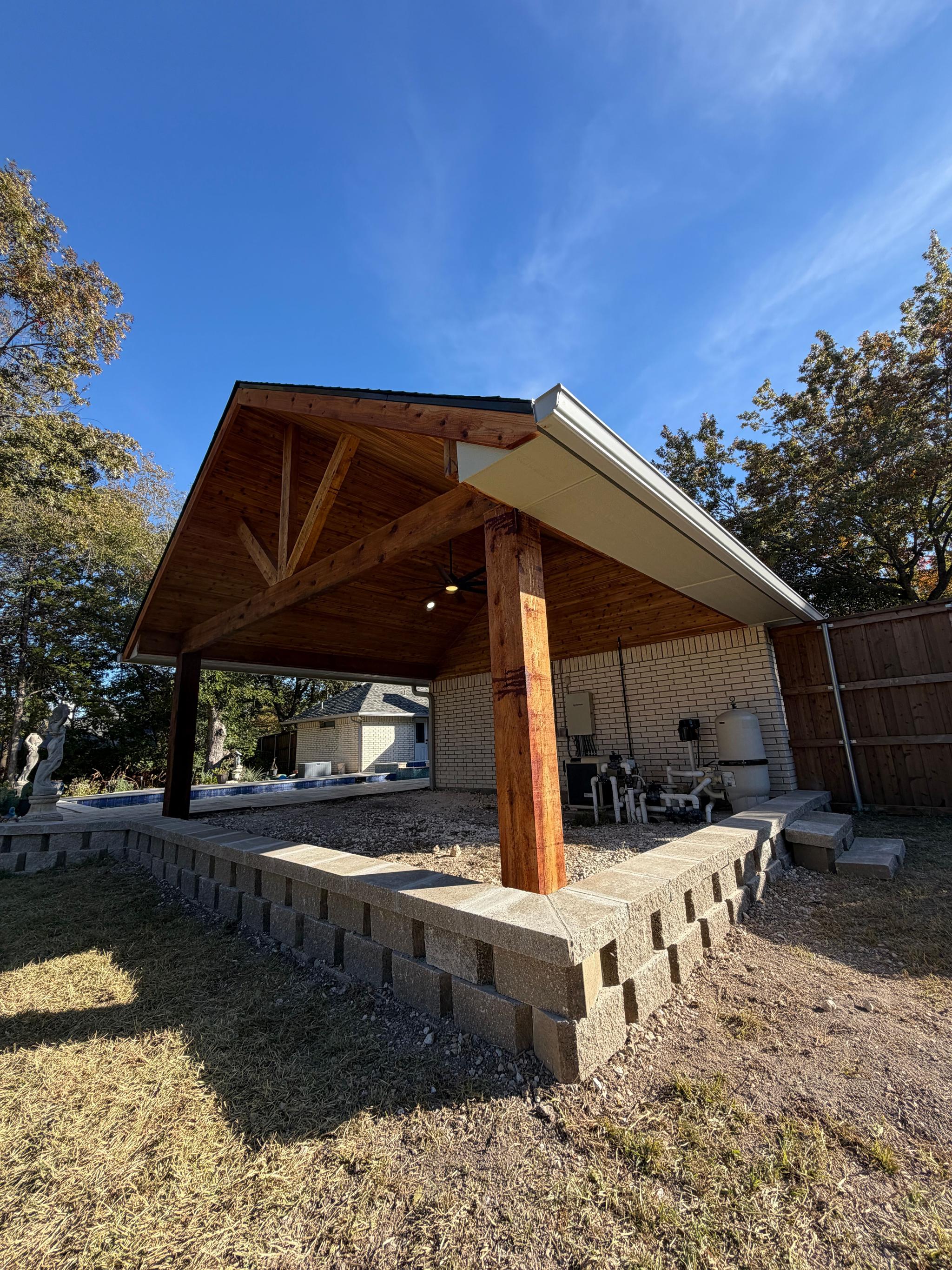
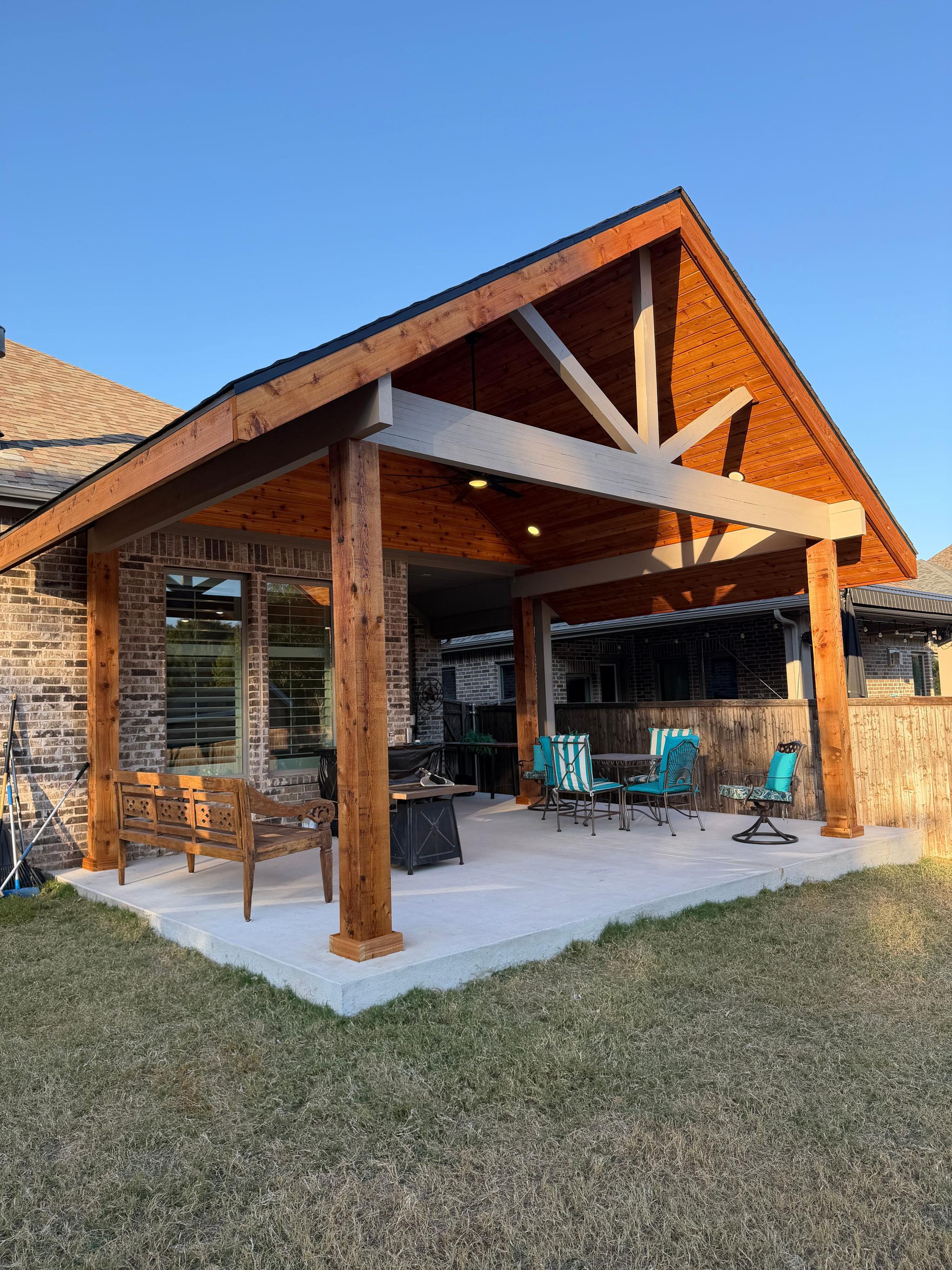
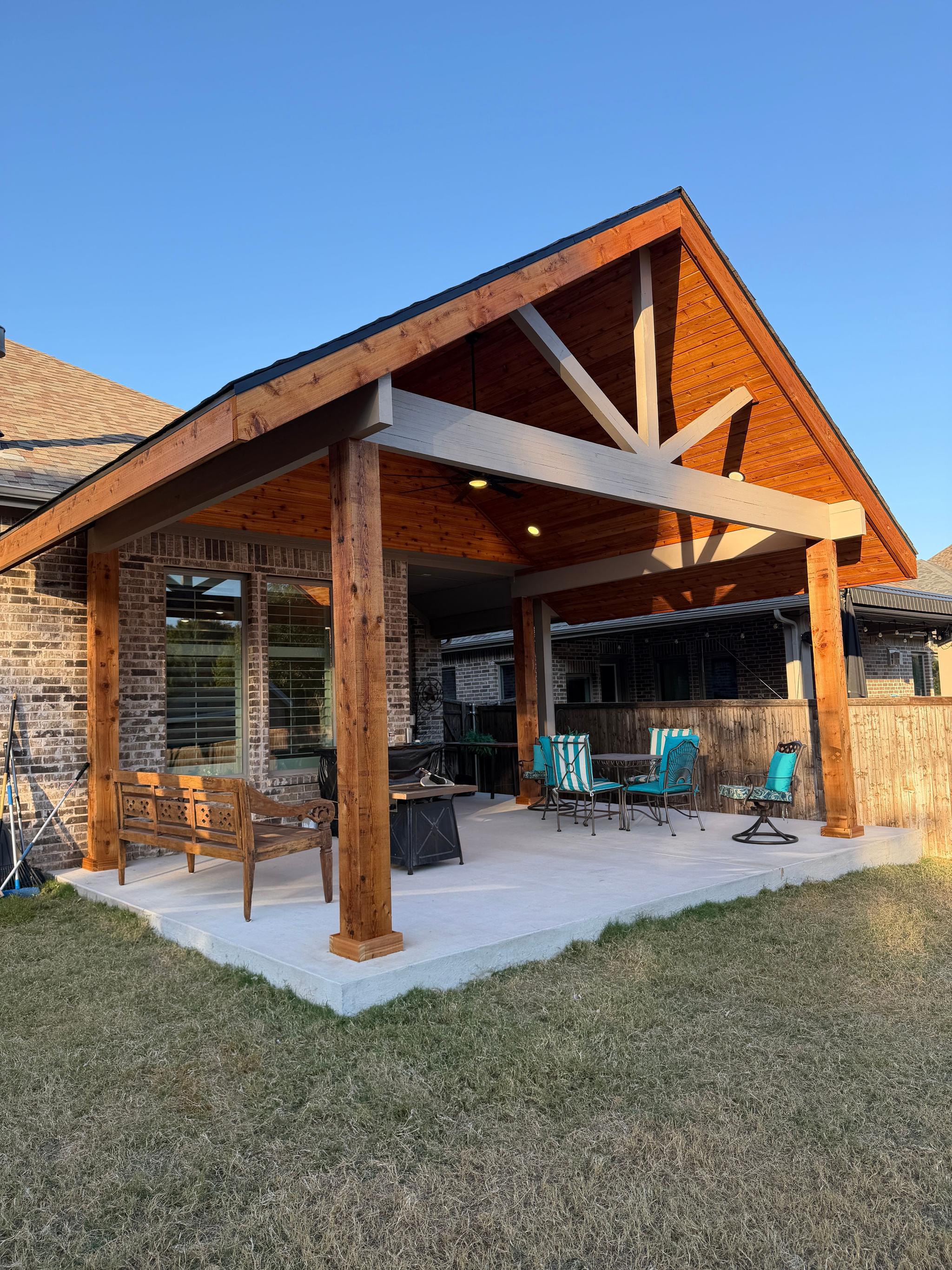
A gable patio cover has a peaked, two-slope roofline — the same classic triangular shape you see on most residential homes in North Texas. The ridge runs along the center of the structure, and the roof slopes down on both sides.
This is the most architecturally finished patio cover style. When done well, a gable cover looks like the builder designed it as part of the original house. That's why it's the most popular style we build in neighborhoods across Frisco, McKinney, Plano, and Allen where curb appeal and HOA compliance matter.
What Makes Gable Covers Stand Out
The defining feature is the peaked roof and the gable end — the triangular wall section at the open end of the cover. That gable end can be finished with stucco, siding, wood panels, or left open with decorative trusses visible. The visible truss detail is one of the most requested design elements we see. It adds depth, character, and a custom feel that flat or single-slope covers can't match.
Gable covers also offer a practical advantage: the peaked roof creates more headroom in the center of the structure. Where a lean-to cover might have 8 feet of clearance at the high end and 7 feet at the low end, a gable cover can provide 9–10 feet at the peak with comfortable clearance at both sides. That extra height makes the space feel open and is essential if you want to mount a ceiling fan.
Pros
- Best curb appeal of any patio cover style
- Matches most DFW home rooflines seamlessly
- Higher ceiling at the peak allows for better airflow and fan installation
- Strong resale value — buyers perceive gable covers as premium
- Decorative truss options add custom character
- Handles DFW rain and wind well due to steeper roof pitch
Cons
- Higher cost than lean-to covers — the ridge beam, gable-end framing, and extra roofing add material and labor
- More complex engineering and longer build time (usually 5–8 days vs. 3–5 for a lean-to)
- The gable end can sometimes conflict with second-story windows if not carefully designed
- Requires more precise roof pitch matching to look right against your existing roof
Best For
Homeowners building a primary outdoor living space who want maximum visual impact. Gable covers are the right choice when your home faces the backyard (visible from the street in corner lots), when your HOA has strict design standards, or when you're building a large cover (16×20 or bigger) where a flat roof would look cheap.
What Drives the Cost
Size, roofing material, truss detail, and finish are the main variables. A gable cover carries more framing and more roofing than a lean-to of the same footprint, which is where the premium comes from. See our full patio cover cost guide for a breakdown of every factor.
Lean-To / Shed-Style Patio Covers
A lean-to cover (also called shed-style or single-slope) is the most straightforward patio cover design. It attaches to your home at the high end and slopes downward to the outer posts. The roof has a single plane — no peak, no ridge, no gable end.
Despite its simplicity, a lean-to cover is a workhorse. It provides complete rain and sun protection, it's faster to build than a gable, and it costs significantly less. For many DFW homeowners, especially those on a moderate budget or covering a smaller patio, a lean-to is the smartest choice.
What Makes Lean-To Covers Practical
The single-slope design means fewer framing members, simpler connections, and less engineering complexity. Water flows one direction (away from the house), making drainage straightforward. The attachment to your home's existing fascia or wall is clean and direct.
Lean-to covers work particularly well on single-story homes where the existing roofline provides enough height for the cover to attach high and still maintain adequate clearance at the outer edge. On two-story homes, the attachment point is typically the wall between floors, which offers plenty of height.
Pros
- Most affordable solid-roof option
- Faster construction timeline (3–5 days for most projects)
- Simple, clean design that doesn't compete with your home's architecture
- Excellent rain drainage — water flows in one direction with no valleys or seams
- Easier to permit in most DFW cities due to simpler engineering
Cons
- Less visual impact than a gable — can look utilitarian on large spans
- Lower clearance at the outer edge (the low end of the slope) can feel tight if the pitch isn't planned carefully
- Not ideal for very wide spans (beyond 16 feet) without intermediate support beams, which can obstruct the space
- Limited ceiling fan placement — the slope means fans work best near the high end
Best For
Budget-conscious homeowners who want solid rain and sun protection without paying for the aesthetics of a gable roof. Lean-to covers are ideal for secondary patios (side yards, back porch extensions), single-story homes, and situations where the patio cover won't be visible from the street.
What Drives the Cost
Footprint, framing material (treated pine vs. cedar), post style, and whether you add a finished ceiling or electrical. A 12×16 lean-to with treated pine framing, composition shingles, and 6×6 cedar posts is the most economical solid-roof build we offer.
Open-Rafter and Polycarbonate Patio Covers
Open-rafter and polycarbonate covers occupy a different space than solid-roof patio covers. Where a lean-to or gable cover is about protection, an open-rafter cover is about atmosphere. The open-beam design creates a defined outdoor room with character and visual interest — but the level of weather protection varies dramatically based on what you put on top.
We build three main variations in DFW:
Traditional Open-Rafter Patio Cover
This is the classic: a series of beams and cross rafters with open sky between them. Sunlight filters through, casting shifting shadow patterns on the patio below. No solid roof, no panels — just wood and air.
Open-rafter covers work beautifully as accent structures. They define a seating area, frame a view, or create a transition between indoor and outdoor spaces. In DFW, they're popular around pools, over fire pit areas, and in large backyards where a solid cover would feel too heavy.
Shade coverage: 30–50%, depending on rafter spacing and orientation. East-west oriented rafters provide the best midday shade.
Cost drivers: Footprint, beam size and rafter spacing, and cedar grade. With no roof deck or shingles, this is the lowest-cost structure we build.
Modern Polycarbonate Patio Cover
This has become one of our most requested builds over the past two years. The structure is open-rafter — exposed beams, open sides, contemporary lines — but translucent polycarbonate panels sit on top of the rafters, providing rain protection and significant UV blocking while still letting diffused natural light through.
The result is a bright, airy space that stays dry in the rain. It's the best of both worlds for homeowners who love the open-rafter aesthetic but can't accept the lack of rain protection that comes with an open design in North Texas.
Shade coverage: 85–95%, with diffused natural light rather than full darkness.
Cost drivers: Footprint, panel grade and tint, and the hardware needed to secure the panels against DFW wind. The panels are the main step up from a plain open-rafter cover.
For a full comparison between solid-roof and polycarbonate covers, read our solid-roof vs. polycarbonate patio cover guide.
Hybrid Designs
Hybrid designs combine a solid-roof section with an open-rafter extension. For example, a gable cover over the main dining area with an open-rafter section extending over the grill or lounge area. These builds create visual depth and allow different zones within the same outdoor space.
Hybrids cost more because you're essentially building two structures with a transition between them, but they're often the most visually striking option — especially on larger patios (18×20 and up).
Cost drivers: The proportions of the solid-roof and open sections, the transition detail between them, and overall complexity.
Open-Rafter and Polycarbonate Pros
- Lowest cost entry point for a defined outdoor structure
- Open, airy feel that doesn't darken the space
- Versatile — works as attached or freestanding
- Polycarbonate option provides rain protection with modern aesthetics
- Great for secondary spaces (pool area, garden, fire pit)
Open-Rafter and Polycarbonate Cons
- Open designs offer minimal weather protection
- Limited shade unless oriented and spaced carefully or panels are added
- Adding panels closes the cost gap with solid covers significantly
- Polycarbonate panels can crack in severe hail (though panels are replaceable)
- May not satisfy HOA requirements in some DFW communities that mandate solid-roof structures
Combination and Custom Designs
Not every outdoor space fits neatly into one style. Many of the projects we're proudest of at Structure1 are custom combinations designed to match the homeowner's yard, architecture, and lifestyle.
Common Custom Configurations
L-shaped covers wrap around two sides of the house, covering a back patio and a side entry or outdoor kitchen. These require careful engineering where the two sections meet — the connection point needs to handle drainage from both roof planes.
Tiered designs use two different roof heights to create visual interest and accommodate varying ceiling needs. A higher gable section over the dining area might step down to a lower lean-to section over a utility space or grill station.
Mixed-material builds combine cedar framing with steel beams for long spans, or use stone-wrapped columns instead of standard wood posts. These choices add cost but create a premium, custom look that standard designs can't achieve.
Covered outdoor kitchens integrate the patio cover with a built-in cooking and prep area. The cover extends beyond the kitchen to shade a dining area, and the structure includes provisions for a vent hood, gas lines, and electrical.
What Drives the Cost of Custom Work
Custom and combination designs sit at the top of the cost scale. The premium over a standard single-style cover comes from additional engineering, more complex framing, and the on-site carpentry skill required to make transitions and connections look seamless.
See examples of our custom builds on the projects page.
Attached vs. Freestanding — Which Do You Need?
This is one of the first decisions you'll make, and it affects cost, permits, and design options.
Attached Patio Covers
An attached cover connects to your home, usually at the fascia board, wall, or roof edge. The house provides structural support on one side, which means you need fewer posts and the cover feels like a natural extension of the living space.
Advantages:
- Seamless integration with your home's architecture
- Fewer posts required (the house supports one end)
- Easier to transition from indoor to outdoor living — no gap between the house and cover
- Typically more cost-effective since the house serves as one wall
Considerations:
- Attachment must be properly flashed and sealed to prevent water infiltration at the connection point. This is the single most important detail in attached cover construction — bad flashing leads to leaks into your home. At Structure1, we use multi-layer flashing systems and always tie in above the existing roofline.
- The height and condition of your existing fascia or wall determines attachment options
- Some DFW cities have setback requirements that limit how far an attached cover can extend from the house
Freestanding Patio Covers
A freestanding cover sits independently in your yard, supported by posts on all sides with no connection to the house. These are common over pool areas, outdoor kitchens that aren't adjacent to the house, fire pit seating areas, and detached entertainment spaces.
Advantages:
- No roof tie-in required — eliminates any risk of water intrusion at the house
- Can be placed anywhere in the yard
- Works well for pool covers, detached outdoor kitchens, and garden structures
- Some cities have simpler permit requirements for freestanding structures
Considerations:
- Requires posts on all four corners (and sometimes intermediate posts), which can obstruct views and traffic flow
- More expensive for the same square footage because the house doesn't provide structural support
- Needs its own independent foundation — typically concrete pier footings 18–24 inches deep
Which Should You Choose?
For most homeowners adding a cover over their existing back patio, attached is the way to go. It's more cost-effective, looks more integrated, and provides a better indoor-outdoor flow.
Choose freestanding when the structure is away from the house, when you want to avoid any risk of roof leaks at the attachment point, or when your home's existing structure doesn't support an attachment (for example, if you have a second-story cantilevered section above the patio).
How to Choose the Right Style for Your Home
With all these options, how do you narrow it down? Here's the decision framework we walk through with every homeowner:
Match Your Home's Architecture
This is the starting point. A contemporary flat-roof home in Dallas looks odd with a traditional gable cover — a modern polycarbonate cover or a low-slope lean-to fits better. A traditional brick colonial in McKinney calls for a gable cover with shingles that match the main roof. Look at your home's existing rooflines, materials, and proportions before choosing a cover style.
Define Your Primary Use Case
- Year-round outdoor dining and entertaining → Gable or lean-to patio cover (solid roof required)
- Casual weekend hangouts with some shade → Open-rafter or polycarbonate patio cover
- Full outdoor kitchen setup → Gable cover or custom combination
- Pool area shade → Freestanding cover (open-rafter or polycarbonate)
- Secondary side-yard space → Lean-to cover (most economical)
Consider Your Budget
Be honest about your budget from the start. On a tighter budget, a lean-to cover or an open-rafter cover gives you the most value. With more room to invest, a gable cover opens up and delivers premium aesthetics. Trying to squeeze a gable cover into an open-rafter budget means cutting corners somewhere — and that's never a good idea on a structure that needs to survive Texas storms.
Check Your HOA
If you live in a planned community in Frisco, Prosper, Celina, Allen, or McKinney, your HOA almost certainly has guidelines about outdoor structures. Common requirements include:
- Roofing material and color must match the home
- Minimum setback from property lines (typically 5–10 feet)
- Maximum height and square footage limitations
- Some HOAs require gable or hip roofs and prohibit flat or lean-to designs
- Most require an architectural review and approval before construction begins
At Structure1, we help homeowners navigate HOA requirements as part of every project. We've worked with dozens of DFW HOAs and know what most of them require before they require it.
Think About Future Additions
Will you want to screen in the patio later? Add a fireplace? Extend the cover further into the yard? The style you choose now affects what's possible later. A gable cover with properly spaced posts is easier to screen in than an open-rafter cover. A lean-to that's built with future extension in mind can be lengthened later without starting over.
Your Next Step
If you've read this far, you probably have a strong sense of which style appeals to you — but you might still be unsure about what works best for your specific home and yard. That's where a site visit makes all the difference.
At Structure1 Construction, we offer free on-site consultations across Dallas-Fort Worth. We'll walk your yard, discuss your goals, show you photos of similar projects we've completed, and provide a detailed estimate — all with no obligation.
Get a free estimate or call us directly at (580) 665-2758. You can also browse our patio cover services and project gallery to see our work across DFW.